
As part of our 50th Anniversary celebrations, Robert Musgrave MBE, Vice-Chair of The Shallowford Trust, has been gathering personal reflections from people who have been an integral part of the remarkable Shallowford story through the past five decades. So, pull on your wellies, we’re going on a journey down memory lane! A new story will be uploaded every Thursday throughout 2026.
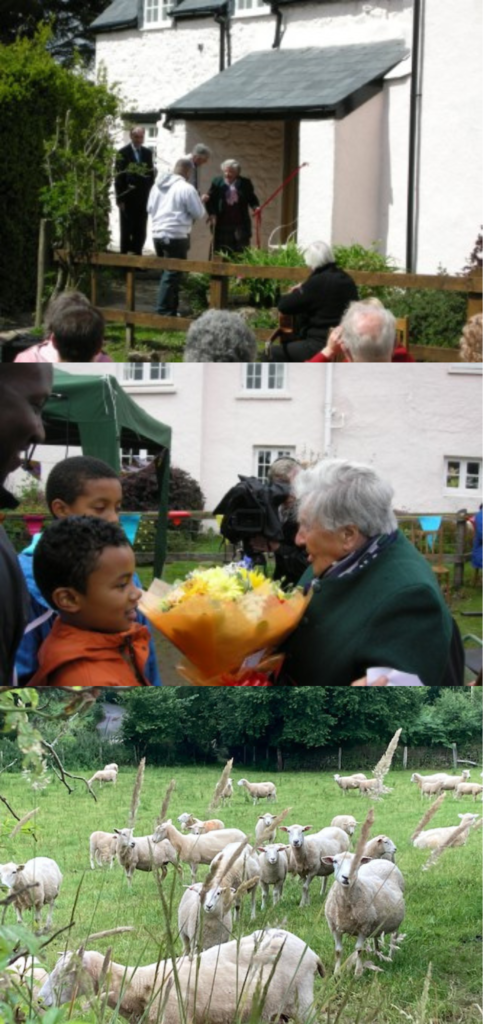
12.Margaret Weir
It was really sort of magical
The first contact that I had with Shallowford was through a local spinning and wool dyeing group that met regularly. There was a group of us, and we’d sit outside in the summer and spin. That was really nice.
And then one day they got in touch with me and said, that there was this lady, called Elizabeth Braund, who needed help with lambing, because her colleague, Rosemary, was unwell at the time. I was experienced at supporting local farmers at lambing time, so I agreed to go over and help, although I knew nothing about Elizabeth or East Shallowford and this wonderful place.
Looking back, it was one of the most exciting days of my life. John brought me over, dropped me off and I met Elizabeth. I remember coming into the farm sitting room, and feeling this is a special place. The fire was alight, and there were a couple of young people from London: Wayne and Sheppey. They had come down from Providence House to help, but they had no experience at all of lambing.
The bedroom I slept in was up the granite staircase. There were bunk beds and the room had a view over the farmyard. Underneath the bunks there were lots of writings from children. Lots of names carved or written into the wood. All making their mark. It was really sort of magical.
When the boys first started helping with the sheep and lambs, they walked everywhere listening to music on their headphones. Over a period of a few days, I got to know them really well and they were great company. In the afternoon they used to go off on the bikes down the hill. We all had meals together, and Elizabeth would say Grace. Those mealtimes were important to all of us sitting around the table together.
One morning, when the boys had come down, we had a couple of lambs that were quite weak from the weather overnight. Elizabeth said, ‘Let’s just put them in the AGA’, but the boys were shocked – ‘You can’t do that’. Elizabeth explained it was to warm them up, and they’ll be absolutely fine, as the bottom oven is not for cooking. ‘You see, see by the time you’ve had breakfast, they’ll have warmed up and be ready to take a bottle.’
Those were special times working at Shallowford. Even though I’d lambed for some years, coming here brought you to a different experience. It really was incredible.
It went on from there for us. We’d keep in contact, help when needed, come over for a meal, attend a celebration service at Dunstone Chapel, or an event here at Shallowford. So many occasions, too, with groups of people by the fireside.
We were even here on the night or the second night before Elizabeth died, and we went up to her bedroom, and she asked for the window to be opened. And we talked about Dartmoor. Of course we talked about Dartmoor.
Coming back today into the kitchen and sitting room brings the memories flooding back.
We will never forget Elizabeth’s burial in Widecombe. The men from London, who had been here as boys, took the shovels from the undertaker and started to fill the grave. I remember them giving their jackets to one of the mothers, who had come. She was quite small, and there she was holding all their jackets, while the boys in their white shirts took turns with the shovels.
I remember the vicar standing there and the locals, and they thought it was unbelievable; but the young men said that they were burying one of their own. There was something very heart-warming that day – a great family, community feel.
It was such a natural thing to do, because they loved her so much. It meant so much to them.
A sense of gratitude was something fundamental at Shallowford. Being grateful for the food that you’ve got and grateful for the life that you have and what we’re sharing now. It was part of every day in this place.
I saw many familiar faces at Elizabeth’s funeral, some from many years before. We talked and smiled: their lives had changed in many ways just by knowing Miss Braund.
I have great memories of this place. The early nativity events. The two big heavy horses in the fields, galloping around and their great hooves. Those moments when Elizabeth was talking about her faith or something, and you could feel the emotion that was there.
And now years later, it’s great to see that everything has progressed outside and the project is going to carry on. Which is all that she ever wanted.
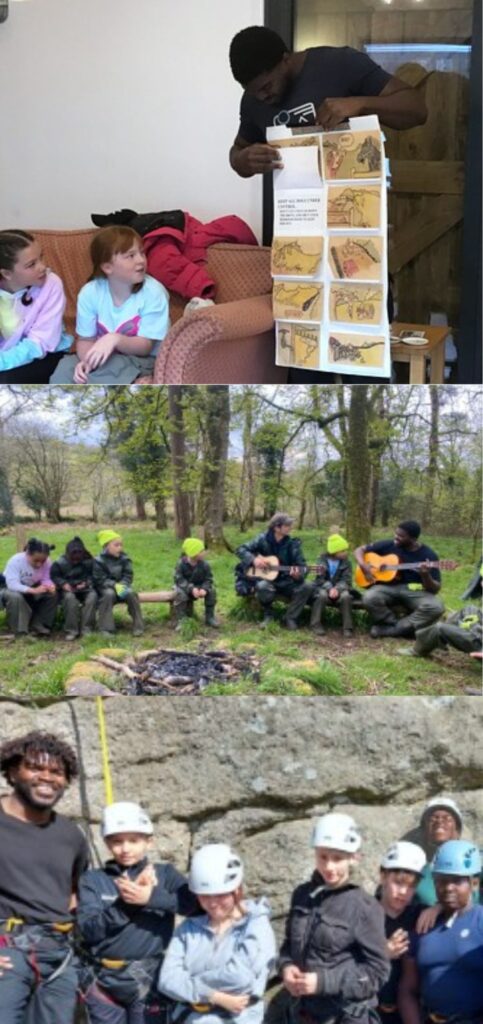
11. David Onah
Finding community.
Source: Audio David Onah.m4a
David Onah is currently Programme Officer at East Shallowford Farm.
Starting out
I first came to Shallowford in May 2021. There was a taster weekend with a workparty group from Providence House.
I had been in Yorkshire on a gap year that turned out to have been longer because of COVID. I didn’t realise at the time, that it was a blessing in disguise, because the longer I stayed, the more I recognised an inclination and a love for the vocation.
So that led me to Shallowford. I’ll never forget sitting at that dinner table the first nights I stayed at the farm, with the Providence workparty and Shallowford team. I was captured by that sense of home, family, community, that I felt over that weekend, and wanted to stay.
So I did. I formally started as a resident intern in July 2021, and I am still here several years later.
Those three things home, family, community still run deep within the Shallowford DNA. The team has grown, the operation has gotten smarter, there are more partner groups connected with new and returning ones. But on the inside, we can still identify that is what makes us unique and we all still feed into that.
There is a forgiving environment at Shallowford. You don’t need to get things right the first time here. That is an empowering thing to me. There is a sense of family here. What I call ‘family-arity’.
The Shallowford mantra is making a difference. I think I’m on the list of differences that Shallowford has made. It has made a difference to me.
I came as a resident volunteer and transitioned into full-time worker; that in itself was Shallowford making the difference.
I find myself thinking that I came to Shallowford sort of pre-cooked, like a pre-cooked meal in the freezer, and Shallowford has finished me. You could almost say I came as a boy, and I have become a man, because of experiences here.
There are so many examples of difference being made in young people’s lives.
One of the most important things is the power of good role modelling. It’s like the umbrella over what we do here. We may not be conscious that this is happening, but that young boy or girl in the corner is soaking it in, almost looking for affirmation, that it’s ok to be nice or to be kind, and it’s not a sign of weakness.
Building resilience in young people, and the adaptability that comes with it, is another big impact. Young people learning, even when they don’t like things or are uncomfortable with things they’re doing. To help them travel beyond surviving something to becoming proficient in loads of things.
It’s the ‘can do’, the ‘I can do this’ that is often the big marker with young people.
It is 50 years since Elizabeth started this project, and from the beginning until now, it is the young people who continue to come first. The importance of make good connections. To be willing to be daring and daring to be different.
It’s about being open, being open in every sense of the word. Being available for people, and for young people, in particular, to find themselves through the encounters you can provide, or the experiences you can create for them.
There are always challenges working here. One of the biggest is remaining gracious in changing circumstances. Not becoming arrogant about how much you think you know and how much you understand, and being able to preserve that sense of service at the heart of the work.
Service, availability, accessibility – they are pretty good summaries of what is needed.
In a word, we are a farm for young people, supporting them in capacity and confidence building, through farming and the outdoors community.
It’s a farm where the young people are completely in control with our guidance, and we aim to help them find themselves, connect with themselves, connect with nature, and hopefully take that on beyond their visit to us.
I have thought of another thing about Shallowford. You can always find colleagues, when you get a job, but you can’t always find a community.
That’s a great thing. You can’t always find a community.
Here at Shallowford you find a community.
Happy birthday to Shallowford Farm.
10.Geoffrey Partrige
Just get one or two to listen
Geoffrey Partridge in conversation with Robert Musgrave MBE at East Shallowford on 30th January 2026.
Geoffrey is a local arborist and environmentalist with connections to Shallowford over many years.
Source: Audio Geoffrey Partridge.mp4
I’m born and bred Dartmoor. I was brought up at Leigh Tor Farm, near Poundsgate.
We were four brothers, and my eldest brother took on the farm. I did study agriculture though, and funnily enough, that’s how I met Miss Braund.
I had started going to Bicton College, and East Shallowford had a young man staying there from London, the same age as me, about 16 years old, called Jason, and he was at the college as well. My parents arranged with Miss Braund to alternate with lifts in the car to college every Monday for day release.
I think that what Jason appreciated was the openness of it here. I remember him saying, oh, it’s so quiet; and how much more slow everything was.
In those days Miss Braund used to drive a Toyota Hilux up and down the lanes. I didn’t know what happened to Jason when he left Shallowford.
For myself I actually preferred working with trees rather than animals, so I took further courses and became an arborist and a tree surgeon. My training took me to a horticultural college at Merrist Wood, near Guildford, Surrey.
Sharing about nature
Over the years,I always had a connection with Miss Braund and Shallowford.
I would lead walks with some of the young people from London. I’m very aware of the countryside and I’m very keen on the river, the fish and the landscape.
I’d come down and do a walk around the ball or up on the moor and show them bits and pieces, show them fish, and show them footprints in the sand and say ‘Well, that’s an otter’ or ‘that’s a rabbit’ or ‘that’s a fox’ and that sort of thing. I’d do short guided walks.
I was probably in my twenties when I started doing those things.
I can remember going up the lane, and the young people all have those ear things on, and I would say ‘You need to take them all off. We’re going to go for a walk, and you need to hear what we’re all about’. It took a while, but once they started, then they began to take an interest and some really, really enjoyed it, and showed a lot of interest in what you were showing them.
There’s so much to share about the countryside – what’s going on in the hedges, the flowers, the different fish in the rivers, how you can always tell the difference between a fox kill and a buzzard kill or any other animal.
Some children got really engrossed in what you were talking about and really keen to listen. They were only a small minority each time
The rest would be sort of kicking their heels a bit. You try and get them involved, but it was very difficult. They were ones who were actually happy to go back home again.
And I think if you could just get one or two to listen to that side of things, of what the countryside could teach, then I think you’ve been successful. If you can change one or two people and actually alter their lives and give them a really good outlook, then you’ve succeeded.
East Shallowford was very much more a traditional farm then. Geese in the yard hissing, pigs wandering all over the place, dogs running around, and people coming and going, it was a busy place. That’s my memory of it, and of course it’s definitely changed, because things move on.
Rose and Miss Braund were farming it, with help from other people, and they were known for that, and as part of the community. The young people came here, everybody knew what she was doing, and it was a great thing; but it was a farm, and it was a family farm. It was Miss Braund’s farm, and it was treated as such, and she slotted in very quickly with locals.
I think there was definitely a lot of respect for them. In fact, my father told me to mind my Ps and Qs when I went there, because Miss Braund was a lady! I was warned – no cussing when you’re at Shallowford!
Rosemary was always a worker, I remember that. She never stopped. Every time I saw Rosemary, she was always on the go, always on the go. Busy, busy, busy.
I suppose, my connection with Shallowford is with lots of little bits.
I supplied logs for the fire. I used to come from time to time and organise a shoot in the woods. I can remember evenings at Shallowford, with local people like Tony Beard and talking about local stories and customs.
Getting people together – that was one of Miss Braund’s things.
A sense of community is so important in these areas, and it still exists around here. And you still have to find time to be with people and speak to people and be part of the community.
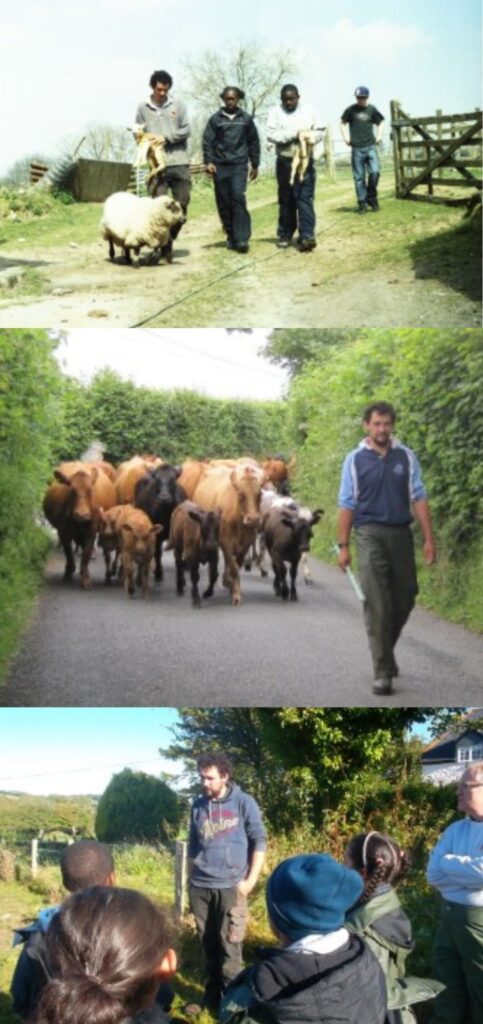
9. Paul Edworthy
A Settled Place
Source: Paul Edworthy Audio 30 Jan 2026.m4a
Paul Edworthy in conversation with Robert Musgrave MBE at East Shallowford on 30th January 2026.
Starting out
When I first came to the Farm, I believe Miss Braund and Rosemary were going to Australia, to see a relative. She contacted my sister because of young farmers’ links to see if there was anybody that could help while they were away for a month.
So I came initially one evening with a few others, I can’t really remember who they were, to discuss how we could help look after the animals when they were away. I was about sixteen.
Then a couple of years later, I had a call to say they had got a grant to do some hedging and they saw my advert in the parish link, so I came to see them, and we chatted about anything but the grant! That would be typical Miss Braund.
Anyway, I worked out what I had to do, so I did start then at Shallowford in a small way.
Unfortunately, I think the main reason why I ended up doing all the work was when Rosemary had her awful accident.
I had been doing some hedging, and Richard Norrish had been mending the Aga. We were chatting outside and Elizabeth came to the door and said, Rosemary’s had a fall. It was about January, February 2008. I remember it was in winter. I went and got Serena and then the air ambulance came.
Miss Braund was then on her own. I’d be working till late and then I’d come in and see her and then gradually, it just naturally happened, I began to look after all the animals and then it went on from there.
I worked out that I was here at Shallowford for about 10 years, from before Rosemary’s accident to a couple of years after Miss Braund’s death.
Buckingham Palace
One of my best memories was going to Buckingham Palace with Miss Braund. Pam Nosworthy and I had been invited as her guests. We all spent the previous night in London and went together to the Palace. It was Prince Charles who presented the MBE to Miss Braund and Rosemary. Rosemary was too ill to attend, so Elizabeth collected both medals.
I felt very honoured to go. Something that I never thought would happen, but it did. It was my first time to London. I am glad they both got the award. They deserved it.
A settled place
I always think the strange thing is that you didn’t know what this place was. As a kid, growing up we would go on a bike ride and ride past the gate. I’d probably been past here 100 times before I actually came into this yard.
And you wouldn’t know that it was any more than just another farm. All anybody knew was, ‘Oh that’s Miss Braund and Rosemary’s place for London kids.’
Even now, you’re in the middle of the moor and you can drive past here and there’s not a massive sign board at the end. It is still a farm.
I always feel like there’s an open gate. When you drive into this farmyard, you always feel like it’s relaxed. That’s not true of all other places, but here it always feels like a good vibe. They’ve still got a good vibe. When you go in this yard you feel settled.
That’s important. It’s important to the groups that visit here as well.
Young people
For several years at lambing time in particular, a couple of lads from Providence came down. Jamel and Patrick. They were both in their way very good. What was special was that you could be one-to-one with them. They could talk to me, I could talk to them, and we would have a good laugh.
We lived completely different lives, but here we were thrown together and it worked well. I learnt stuff from them, they learnt stuff from me. I think they were relaxed here and belonged.
One funny thing I recall is that when the kids came from London in the lambing season, we would have lots of lambs on a Friday, nothing on Saturday and Sunday when the kids were here, and then Monday there’d be loads of lambs again. Nature’s a funny thing.
Miss Braund and Rose
I didn’t really get to know Rosemary, because I only started properly at Shallowford after her accident. I would class Rosemary as the farmer. Her life was with the animals. She would be the one outside, feeding the animals, getting the horses out.
She was a softer person to talk to and I think she seemed very relaxed when she was outside. She was calm, quiet, and just got on with the work.
Miss Braund was someone you respected. She didn’t take fools easily. It was best to be straight talking with her. She respected that. Firm but fair, I would have said. Her heart was in the right place all the time. What I learnt from her was that if you work hard and have respect, you’ll get there. Be firm, do the work and it will pay off. Miss Braund came to my wedding, too. That was only a short while before she died.
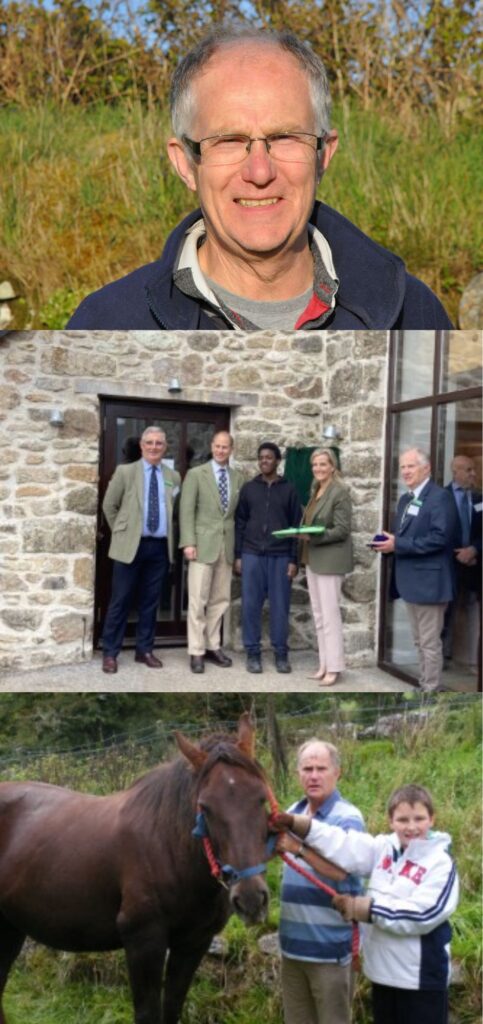
8. Robert Musgrave
Robert Musgrave MBE, Deputy Chair, The Shallowford Trust
Sources: Extract from chapter A303 from One Year is not enough by Robert Musgrave
It is one of those memories etched on my mind, the bigger shapes and picture clear, the details blurred with the passage of time. October 1975. Providence House car park. Not much has changed there – dark grey tarmac, in front of the dark brown brickwork, and white steel framed, Georgian wired glass windows. A white Ford Transit minibus, soon to be loaded with people, and a white panelled lorry, slowly being filled up with the furniture and paraphernalia, thought to be needed to start a new project. To a hill farm on Dartmoor. Me helping load everything in the vehicles. Me waving the group goodbye. That first minibus that went from here to the farm, and me not being on it; but little did I know how many trips in subsequent years I would make and how many thousands of miles I would drive up and down the roads to Devon.
The open spaces
One of the biggest contrasts is encountering wide open spaces. From the front door of a flat there may be only a shared corridor. There may be scrap of yard or a few yards of garden if on the ground floor. The green spaces are squashed between more buildings on the housing estate. The commons or the football pitch are more like an open space; but it is not the same. No way is it the same as the sense of space the young people – indeed of every generation – have experienced in coming to East Shallowford and Dartmoor. Even a single step outside of the farmhouse or of the new barn accommodation brings you face to face with the open valley, the hill rising to the sky across the river, and only the hint of a building or two half a mile away along the lane, that runs along the foot of the hillside.
The Heart of the Matter
The summer of 2023 marked the end of my fifth decade of being a part of Providence House, and a proof that one year is not enough. It never was. There are many reasons I stayed so long, and one is because of the vision and realism of Elizabeth Braund, the founder of Providence House and East Shallowford. Beyond the mud and mayhem, anxiety and euphoria, there was always a bigger picture. I hope that the prospect of that has kept me coming back to the window. It is easy to miss the window for the desk, or the horizon for the immediate.
Elizabeth Braund was a hard woman to work with in some ways and many of the hardest times for me at Providence House have been in connection with her, as have some of the most inspirational, and the most stimulating to profound thinking.
My task at Providence House, and in connection to East Shallowford, has been to be a sustainer, a continuer, a connector, a facilitator.
This old farm seems like a long, lost friend
It is a funny thing to say that I stayed at Providence, in part because of East Shallowford Farm, as it probably brought me more grief over the years than all the shenanigans of disruptive youth at Providence House. But what it gave me, as it has given to countless numbers of people, is an enriched life. A home from home, a belonging, a connection with nature and God’s world to make your own, a spaciousness, a challenge, a place of both re-connection and a healing.
On a visit to the farm, I interviewed some of the eleven-year-old children about their experience, and young Jeremy said that he liked the farm because it was ‘earthy!’ I too like the farm because it is earthy. Sometimes I used to drive the minibus out of the farm gates, turn leftwards up the steep hill, and start to sing the words of a John Denver song: ‘Sometimes this old farm feels like a long, lost friend. Yes, ‘n, hey it’s good to be back home again.’
It is a long way from Wandsworth to Widecombe. Almost each time I drive, I think or someone says, it is a long way to ferry children for a week or a weekend. Couldn’t there be somewhere nearer. The answer is no, and each time it is no, for at least something like this reason. When having laboured over hill and dale, along long grey roads for what seems an age, and having chugged up onto the moor, from Bovey Tracy, the last lowland town, past Haytor and its almost symbolic rocks, you turn the brow of Widecombe Hill, and you see it for the first time properly. The great sweep of Dartmoor, and its green hills rolling backwards seemingly forever. You know it’s not for ever, and you know it is not a mountain top, but you know it is nothing like London, and all of a sudden, your eyes are opened to something bigger, something broader, and we are going there, into its heart, through its doorway.
Young people and families are still coming through that gateway, and the next generation of the East Shallowford team is acting as welcomers and educators. And this, we are still firing up the engine of the minibus outside Providence House. And this, we are still burning rubber on the A303. And this, we are still turning the brow of Widecombe hill to open up the vista of new opportunities. And that is the heart of the matter.
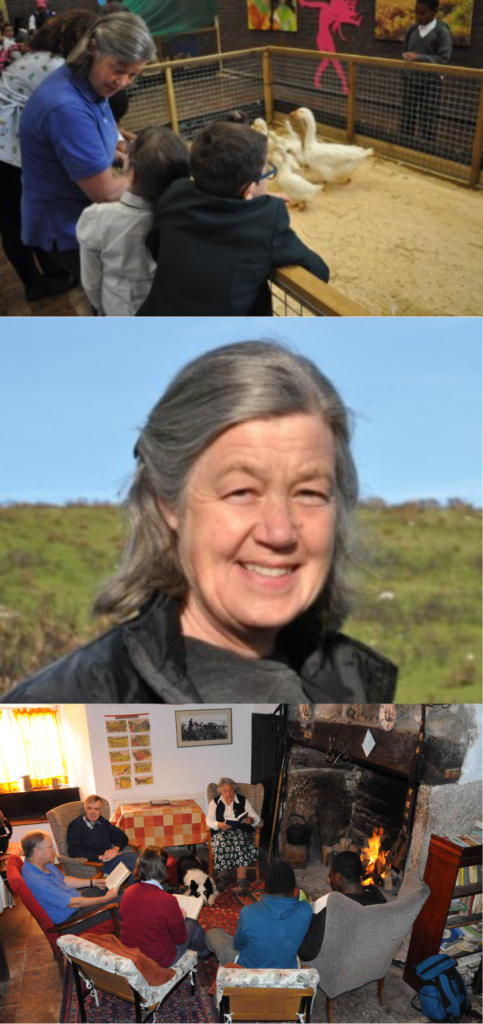
7. Serena Walcot
I thought Wow! What a privilege!
Sources: Serena Walcot Audio 21 Nov 25.m4a
Serena Walcot, Shallowford Project Manager 2005 – 2024, in conversation with Robert Musgrave MBE at East Shallowford on 21st November 2025.
I thought, wow, what a privilege.I actually live on Dartmoor, down the road from the farm, and I have all this countryside every day, that young people enjoy so much, but they only experience when they come to visit. I just wanted to share it more and more with people.
Some of the benefits of London children, inner-city children, coming to Shallowford? Just that it’s totally different. They experience dark skies, and quiet. Some of them didn’t like it, but most of them did. Most of them appreciated the complete difference. They learnt that you could grow things which they hadn’t thought about in London.
Something that always amused me was that having been driven all the way down here, but by-passing the towns, they had little idea that there were supermarkets and schools not far away. I remember at one meal getting the ASDA tomato sauce out and a child asked if I’d gone to Clapham Junction to buy it!
Shallowford was such a complete contrast for so many.
One of my earliest memoriesof Shallowford was around 1992 or 3. We had only moved to Dartmoor a short while before. I had been introduced to Elizabeth when she held her Tuesday evening Bible studies at Shallowford, which were so helpful in nurturing faith. I was subsequently invited to help when the Providence House families’ weekend took place that summer.
That was quite an eye-opener. Four or five old minibuses pulled into the yard and a very noisy bundle of people fell out, all shouting and greeting each other. And I remember being slightly intimidated. I thought, ‘oh my goodness, who are all this lot?’ They were just so noisy and I didn’t know any of them. But it was lovely. And I very quickly got to know them.
Quite soon after that, I must have come to a Providence Carol Service in London. It was just lovely. I remember as I arrived in the hall, there was a ripple of whispers – ‘that’s Serena from the farm’. Gosh, they all know me. Wow!
So next time it was the families’ weekend, I loved it because I knew most of them, and it was so special to see what a family it was, and how much they all loved the farm. The farm, as they called it, was so special to them.
I think Elizabeth Braund was a visionary before her time. From when she first started in Providence, she could see how important it was for children to meet together and to have something to do, and then to bring them first to Wales and later on to here was just amazing.
She was a woman of ideas. The family weekends were her vision.
I think that was a lovely idea to bring down the parents to see what their children had been up to, and perhaps the younger ones so they could see what they could do later on, and to give them all an amazing weekend. And we had many, wet ones, muddy ones, and tents blew away or leaked. Nobody ever seemed to complain. I was amazed.
The farm to city was her idea, and which of course was repeated after her death and is now a feature every few years. So that was an amazing thought, that that could actually happen. She said, ‘I’m going to bring the horses up to London’, and she did, and they stayed at Young’s Brewery overnight in Wandsworth.
She was not afraid to ask people. She had connections in high places and would always ask, and expect, and somehow got things. She had amazing ideas and went through with them.
I would like to know, if I visited in a few years’ time, that there was still the idea of family and love, so that when children got off the bus, there was always that smiling face, whoever they would meet. That visitors would know that it’s different here, and if you were nervous, you would have the confidence that these people would look after you and it was okay. It was safe. That there would always be lots of new experiences that they could all try.
And they still had the fire, and that apart from the middle of summer, the fire was lit in the house. I would hope that Shallowford can still provide a Christian input to all visiting groups, which I know has been valued in the past.
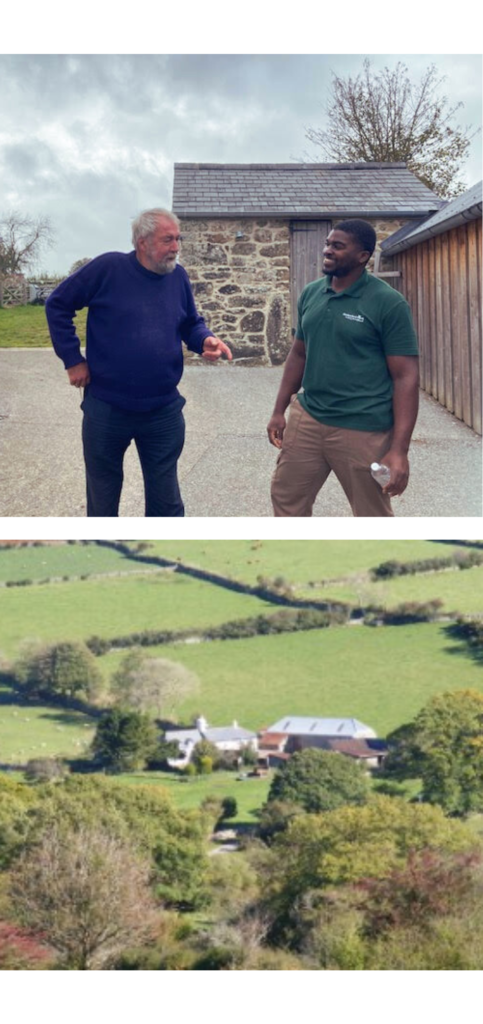
6. Willem Montagne
Very important moments
Source: 2 Willem Montagne 171025.m4a
Willem Montagne, retired Dartmoor Education Officer, in conversation with Robert Musgrave MBE at East Shallowford Farm, 16th October 2025.
When did I first get connected here? I’ll pin it to my daughter. She is 40, and I must have started working for Dartmoor National Park about two years after she was born, about 1987.But when I first came here, I was already several years into the job.
Something real going on here.
It’s funny, that this place, and its running, lies very much at the heart of what I felt about where National Park Education should be: providing real experiences for young people. There’s real farming going on here. There’s real contact with animals going on here. It’s missing out on those real experiences, which I find so sad for a lot of children.
I always I found Elizabeth’s approach to be kind of original, because I don’t think I’d come across anybody else doing something similar. Fitting in very much with my ideas of the importance of the direct contact, making sure you don’t deprive people of the touch and the smell and the direct experience, and always trying to open up experiences.
I had, quite frankly, very little idea about her background or where she was coming from. I knew there was a religious or evangelical zeal there somewhere.
Coffee on the go
I remember coming here and it was always wonderful because you’d come into the farmhouse, there would be all kinds of kids scattered around the house. There would be coffee on the go, breakfast on the go for the young, and you can muck in and have a nice sort of cosy chat, or longer expansive conversation with Elizabeth around the aga.
I would discuss whatever tasks the young people could do, sometimes quite ambitious jobs. Often conservation work in the morning, a hearty lunch, and then an afternoon walk to a curious part of the moor.
If I had one sentence to describe Shallowford I would simply say it was all for the good. Education for everybody all round. Always charming and positive.
Direct experience
The animals and the connection with the land it’s on, that is the important thing; and that’s something that’s a reality which a lot of children don’t get, or they don’t get that connection very strongly.
I’ve always felt all of my life as an education officer that I was fighting with certain, as I call it, ‘forces of darkness’, that seem to want to put something between children and direct experience.
Let’s say you’re taking a group out onto Dartmoor for a walk. You’ve got 101 reasons why you shouldn’t scramble up that tor, why you shouldn’t cross that boggy area, why you shouldn’t cross that stream, why you shouldn’t go over rough ground, why you shouldn’t go into a bramble or gorse patch.
I always felt my job was to give licence to be able to do those things. Because without those experiences, you just don’t learn a thing. That I think Shallowford has done well. The limitation of experiences for me lies very much at the core of what is not right.
I know that in my heart that children paddling in a stream is a good thing. Make it possible: there are risks, but minimize them and make sure it can be done.
Perspective
We took a group of young people onto the moor, and one lad couldn’t understand why people standing on a tor some distance away looked so small. For the first time in his life, he was learning about perspective.
On another occasion, it was a sunny day, and a cloud shadow crept across whole moor. A boy asked if it was pollution? He didn’t understand, because he had never experienced it before. Now he had.
I think these are very important moments. I hope Shallowford can continue to provide them.
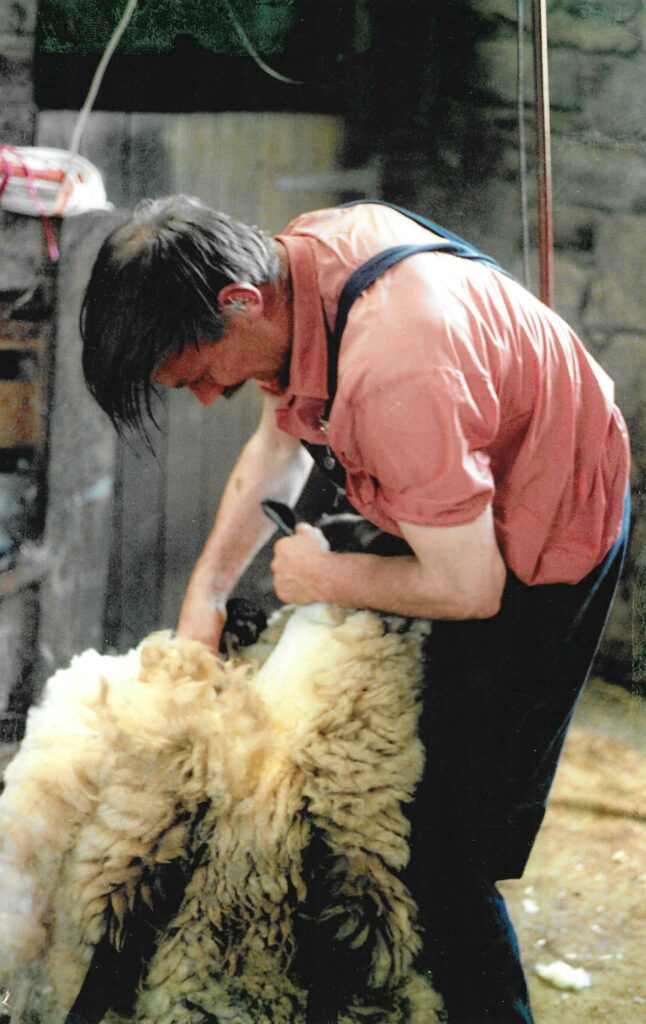
5. Terry French
The great fire at Shallowford & other farming tales
Sources: 4 Terry French Main 16.10.25.m4a / 1 Terry French 16.10.25.m4a
Terry French in conversation with Robert Musgrave MBE at East Shallowford on 16th October 2025.
The barn on fire
I can remember that I was working with Richard Norrish over at Foxworthy. It was a Sunday afternoon, in the 1980s. I said to Richard, there’s hell of a smoke coming out from Shallowford, and he said, we’ve got to have a look. We jumped in the land rover, and we came out here, the barn was ablaze. It was a hay fire.
In the barn there were a lot of old bits, carts and things; so we took them out and put them down in the meadow for safety, and then the fire engines came. Now, of course, this is the new grand barn accommodation at East Shallowford.
Water troubles
I remember coming to Bagpark Manor and meeting Miss Braund, not many months after she first arrived in the village. I was working for Patrick Coaker at the time, and there was some trouble with the water, and we had to lay some pipes. That was 50 years ago.
Richard and I also ran some water for her at Shallowford. We were laying a water supply from the top fields running down. We were up there, somebody was digging the trench and Richard and I were laying the pipe along the trench and I said to myself, what’s that sticking out of the side of the trench? It was all telephone wires, you see, and we’d cut off the line down the valley.
That created merry hell with some neighbours, and the telephone engineer, when he came out wanted to make us liable; but he soon changed his tune when his van was stuck in the mud, and he needed us to tow him out.
Sheep shearing & other farming
I remember, too, with Richard putting the roof on the shippon after the old one blew off, and doing a little bit of stonewalling for Miss Braund; but it was sheep work I did most.
I was shearing sheep here, on and off for 25, 30 years, until I had my hips done, which was around 2007. I would come springtime for lambing. Then in May time and tail dock sheep for her. In June for shearing, as well, of course, for anything else that cropped up.
I taught Rosemary to trim the sheep’s feet. She just needed the confidence to do it, and when you’re telling somebody to do something, you’ve got to give them confidence and say, ‘you’re doing a good job’.
I could shear with electric shears when I was 14. I started with hand snippers, when I was about 8 or 9. And Grandfather, he didn’t mind me snipping away, even if I was making a mess with it. When I finished, he would tidy it all up. But you learn, you learn by your mistakes. Always, always watching, aren’t you? That’s how you learn.
I used to come to help get the sheep in. Miss Braund had a sheep dog, who was useless as that cup, and didn’t make any difference. So, she’s trying to get the sheep in one day and I came and I said, do you have a paper bag, Miss Braund? Of course. So, I took the paper bag, and I put a couple of stones in there, little pebbles in the bottom. The sheep are used to their nuts with feeding. I went out to the Barn Park gateway and just rattled the bag. And they all came running. Straight down over the hill, you see. I said, you learned all these little tricks from watching.
Shallowford and Benefits
Shallowford has done a lot of good for the kids. Some children never saw a cow, never saw a sheep, a pig, any kind of animal, till they came here; and they wouldn’t go near the sheep, so I said, ‘sheep’s not going to hurt you’.
I think she’s done a wonderful job for the children. They didn’t know – where their milk comes from, where their eggs come from. I think it’s definitely made lives a lot better for a lot of children that have been able to come here.
It’s a farm.
Miss Braund came but she didn’t change the farm as such, she changed the farming style to suit the students that were coming here, showing them how to look after the animals.
It hasn’t changed, the farm hasn’t changed.
4. Rosemary Bird
Co-founder the Shallowford Trust
Source: Conversations with different people
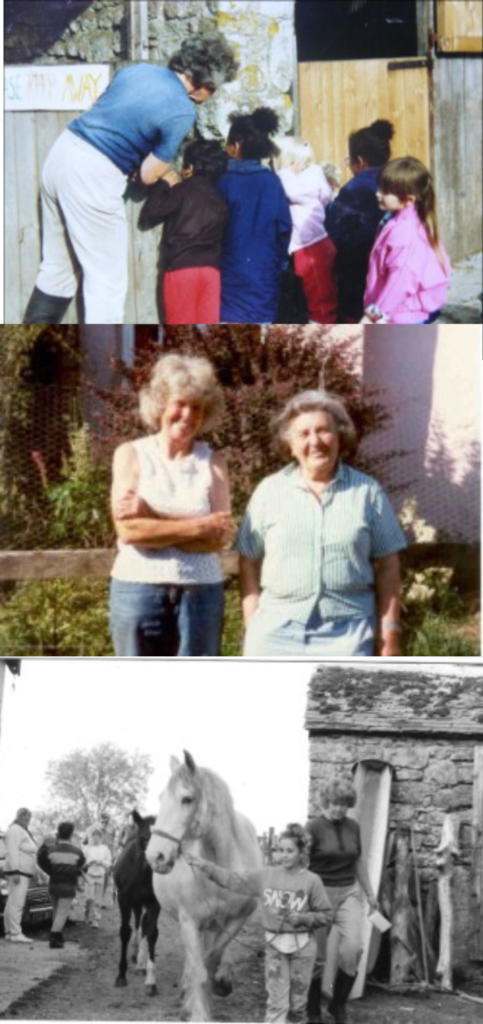
‘I don’t think you can underestimate the value of good role modelling. I do think you can sham it, and make it about yourself. About a good worker there is an authenticity. It is more than skin deep. When you scratch the surface, it is still there. It is like Brighton rock, through and through. That was Rosemary – through and through.’ Robert Musgrave.
‘She was one of those people for whom faith was something you stuck at and that stuck to you.’ Robert Musgrave.
‘She was a Christian lady who had no enemies, a fine human being with a deep faith, whose life was dedicated to the care and service of others.’ Rev Edgar Daniel.
‘Rose never seemed to lose her temper, even when we played tricks something rotten.’ Bob Read, one of the first members of the old Providence.
‘I always remember Rosemary’s greeting when I came to the farm, in a sing song voice saying, Well, hello-o-o-o.’ Doug, who came to the farm as boy, man and driver.
‘Rosemary was always the person that opened the door. She had this lovely smile and hello, which was just so friendly and welcoming, wherever she was.’ Serena Walcot.
‘My strongest memory was being on the farm during lambing, and one morning Rose woke me up at 3am, and asked if I would help her with some lambs that had been born in the field. I quickly got up and met her outside. It was a very cold and frosty night. We found the sheep with two lambs and Rose picked up the lambs; then looked at me and said, “you bring the sheep”. My hands were freezing, and the sheep’s fleece seemed to be covered in frost. I buried my hands in the wool, and they were so cold I thought they would drop off. Somehow, I managed to keep hold of the sheep, and following Rose and the lambs, we got safely to the shed. That’s when I learned what Rose’s work was all about.’ Phil Dorman.
‘Rosemary Bird was at Providence House long before me. She wasn’t there at the very beginning of the life of Providence. She came first, along with other willing volunteers, and it wasn’t long before she was drawn into the work with young people in the mid-sixties, while studying as a physiotherapist, then working as one at Westminster Hospital, along the Horseferry Road.
‘When the new Providence was opened in 1970, and there was far more demand for people’s time, she took a part-time job in Battersea, at St John’s Hospital.
‘My earliest memories of Rosemary at Providence House are of her arriving from the hospital, grabbing a quick lunch and straight into whatever was happening in the club, and the day not ending until the last sweeping was swept up and the last set of lights turned off.
‘When the project to the farm began in that first year of experiment in the autumn of 1975, it was goodbye to paid or salaried work for her for ever. Somehow it all worked out, until her fall in the winter of 2008, from which she never fully recovered, and finally passed away on Sunday 10th January 2010.
‘I never knew a woman so humble, so patient as Rosemary, who in her fitness worked all the hours God gave her, and in her weakness graced her room with a smile, a look with laughter in the eye. Even in her last wheelchair months, she spoke with a prescient movement of her eyebrows, an understated word that veiled a knowing.’ Robert Musgrave.
Last word from Rosemary herself, which was typical of Rose, not wanting to draw attention to herself:
‘But Elizabeth and I get on well because we’re totally different. Couldn’t be more different. I mean, she is somebody who has a flair for innovating things, and I will plod on and do the background things. But we are very different, very different.’ Rosemary Bird in BBC interview with John Govier.
3. Mark Butler
“It’s a Long Way from Battersea”
Mark Butler, Estate Warden, Duchy of Cornwall remembers Shallowford
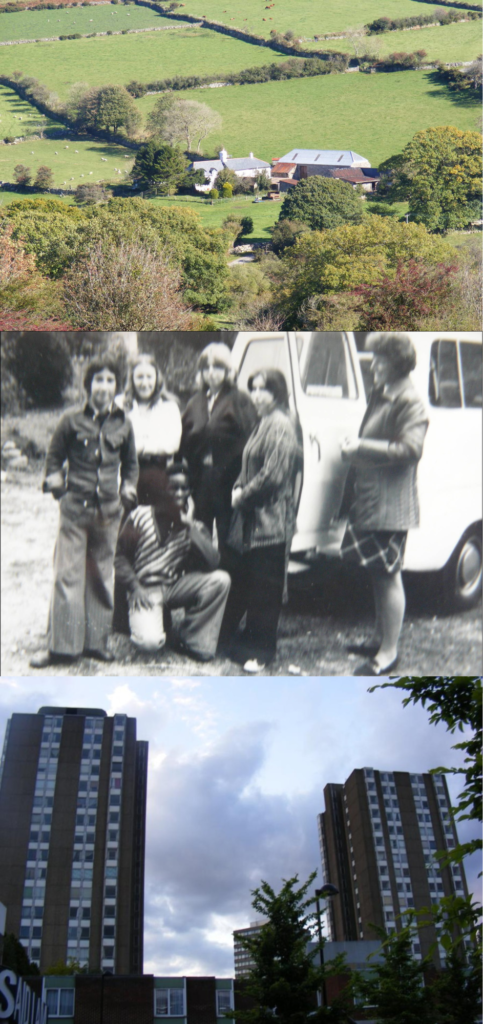
I came to East Shallowford over New Year 1979, when I was 9 years old, being the youngest in a group of boys. It was with Providence House (youth club) and we came down in the old blue van. We walked to Widecombe in the freezing snow. I think I cried all the way.
I remember the boys – My mates Spencer,Leigh, Rickie, Darren, and Trevor – who the pony threw in the field, and his brother Tracy, who rode another pony that just sat down and rolled over. Mark Baxter was there who lived two floors above me behind the youth club in London. There were others, most of whose names are still in the visitor book at the farm. Mine isn’t. In truth I might not have been able to write in those days.
We went to Bellever, and got freezing cold in the river, then I lost my too big welly boots in the mud near the farm gate and had to go home in my socks. Although I knew we were on Dartmoor, I had no idea where it really was. We went to church, with a striking view of the hills. We all had tasks to do: washing up, peeling potatoes, mucking out the pigs. The first time I ever saw a pig was on the farm, and as an adult I have reared my own pigs. Miss Braund would tell us Bible stories, give us homework to do on the dining room table, and serve us hot orange juice by the great fireplace. Ever since I have had my own house, I always made sure there was a fireplace. There was a table tennis table in the barn, and also stacks of bedding straw, which we were told not to climb on – but of course we did.
I think it cost a fiver to send me down here for the week, and my Mum said it was the best fiver she’d spent to get rid of me for a week! When I got back home the first thing Mum did was put me in the bath.
I lived in Irving House, Livingstone Estate, close to Clapham Junction station and from our flat we could see the trains all day, every day, and heard them all the time. It was all a bit wild west living on that estate. I grew up close to drug dealing, police raids, and all sorts of goings on. When we were 15, 16, lads were getting into trouble, going to Feltham young offenders, in and out of Battersea Police Station. But I didn’t want that and started going to Providence House Youth Club, costing 2p collected in an old marmalade jar.. I wanted to get away and lead a normal life and think if I’d stayed there, I would have ended up like so many of the other lads; so as soon as I was old enough, I joined the military, and by 18 was in the Royal Marines and never looked back.
I spent many years in Plymouth, and lots of my training was on Dartmoor and learned to love the countryside, and once I was able to own a house, I made sure it was not in the city. I now live at Belstone on Dartmoor, in an old cottage, with great views across the moors. It’s a long way from Battersea, and I feel so privileged that a boy from the city can have this amazing outdoor job as an estate warden for the Duchy of Cornwall.
My interest in nature was stimulated all those years ago. In Battersea we would fish for eels at low tide on the Thames, or swim in the Queensmere pond on Wimbledon Common, or follow the deer at Richmond Park. Family holidays were in Cornwall, so from an early age I was introduced to the countryside.
Then one day before Covid, we heard on the news an item about an emerald brooch found in a chest of drawers that was being prepared for auction – linking back to Miss Braund and the farm. I couldn’t even remember the farm’s name, but worked out where it was on the map, and my then wife and I drove to Shallowford, and reconnected after all those years.
2. Debbie Dowman
“A Good Addiction”
Debbie Dowman first came to Shallowford on a school trip as a teenager, back in 1978 – and four generations of her family have continued the tradition.
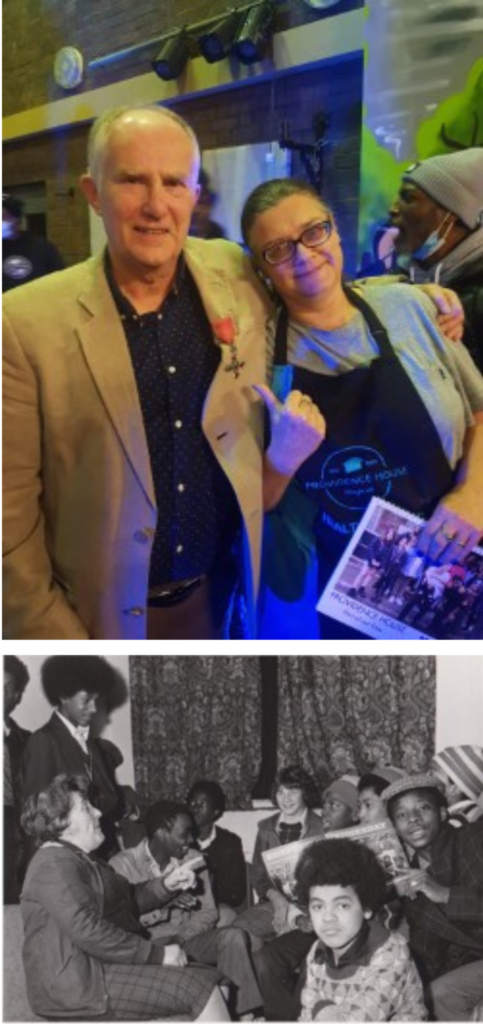
I first came to East Shallowford Farm in November 1978 from Battersea County School and it was very cold. I didn’t know Providence House in London at the time, or the farm’s connection. . I had just had my thirteenth birthday and remember my dad dropping me off at school, because my mum was in hospital having given birth to my brother. My first memories of Shallowford – it was amazing. We were all so excited, it was so different to Battersea.
I remember in the barn they had a makeshift badminton court although the house was like it is now, apart from the horrible metal bunk beds upstairs. We used to call them prison beds. We loved the amazing open fire – I’d never seen anything like it. And I still haven’t even after all these years. We helped with household chores and one day we made a lemon meringue pie, I had no idea that meringue was made out of egg white, and that if you just keep whisking, it forms – it so fascinated me. Mind you, I have never made one since!
We would be driven to the village; but I did take a walk on my own one day, without permission. I wanted to go home, as some of the children hadn’t been too nice to me and I had enough. I walked to Widecombe where there was a phone box – it cost 2 pence a call. I phoned my mum and dad but there was no answer. Then I went to the shop and bought a big selection box, and sat on the wall outside. Suddenly, Miss Braund pulled up and said, Debbie, get in the car now. On my first visit, I wanted to go home, but ever since, I’ve wanted to come back.
I never returned on a school trip but in 1992 I returned with my family. By this time, I was involved with Providence House, and joined in with a families’ weekend. It was wonderful. I was really happy to be back – it was still the same, but now I was bringing my own kids. And now I am addicted, it is the best addiction you can have. Shallowford does something to you, you feel very much like it’s part of me, a family, it feels like home. It actually makes me feel closer to God for some reason, perhaps it’s the beauty of Dartmoor. It’s like you see his hand, his hand print there. I mean it’s beautiful.
Four generations of my family have been here. My mum and my dad, sisters and my brother, in fact my dad used to drive a group in the minibus here. My husband Shane, and our two children, and now each of their children, grandchildren and partners from all both sides of the family. My nephew Antony lives on the farm. I’ve been here as a punter, as a beneficiary. I’ve been here as a helper in the kitchen and with youth groups.
I think the changes to the farm have been so well done. Mind you, I do miss the chickens and the geese strolling around; and seeing somebody randomly walking past leading a cow. Each evening they would bring the horses in. I loved seeing that. I remember some of the outings we went on. We climbed Haytor, visited the Ten Commandments and visited a quarry, which was so muddy my friend’s boot came off. We had so many laughs. One thing is that each time I come down here, it’s different, so though you’re at the same place, the experience is always different.
If I had only one thing to describe Shallowford, I have just one word: Amazing. Oh, and it’s an addiction. It’s a happy addiction. One thing I’d like to end with: I think it’s really lovely that my daughter, Anita, is a Trustee at Shallowford, and who would have thought that back in the day!
1. Elizabeth Braund
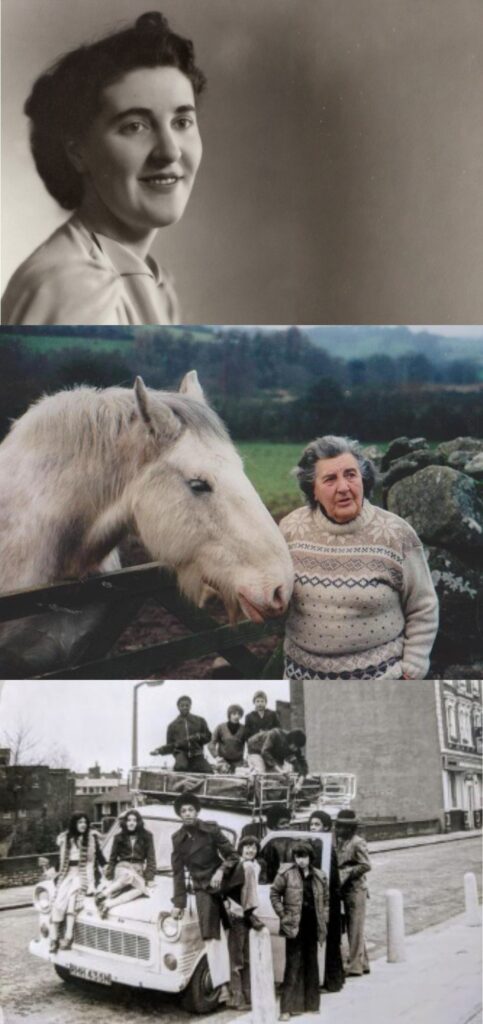
Fifty years ago this day, Elizabeth Braund and Rosemary Bird had already spent their first Christmas and New Year on Dartmoor.
Nine months later, they would have been established at East Shallowford Farm, with the first group of young people there. Young people have been staying ever since.
In an interview with the BBC, Elizabeth said, ‘This idea of having them at all, came from me having lived among the families in south London and knowing very well the life of the housing estates and how cramped it is in many ways and how a lot of kids grow up there.
‘Young people see growing things and they may vandalise them, probably not realising what they are looking at, and very often don’t have the opportunity of going out of London into a real country situation. We wanted to give that opportunity. Here at Shallowford, they have to share in the life of an ordinary farm. And that means they have things to do in the house. And that means, too, they begin to work together.’
Elizabeth went onto say: ‘We’ve got a lot to be very, very grateful for in the way it has been and the people who have supported us along the way. Hundreds of kids and several generations have been part of this, and the young people who’ve grown up themselves and then come back to us, and have been a great help to us and come back again and again. We’ve enjoyed all that! In between all the upsets we have had! And there’ve been a few of those too!’
Elizabeth never wavered from the conviction of the value of the project, especially for those who stayed ‘long enough to have lasting effect.’
She never changed from that opinion.
Since those first pioneering days, hundreds, if not thousands of young people have benefitted from residential stays at East Shallowford Farm. Rosemary died in 2010 and Elizabeth in 2013, but the work of The Shallowford Trust continues.
This year we celebrate 50 years with a series of events and activities.